
The Problem With Boredom: Why Kids Need More Than “Something to Do”
May 4, 2026 • 5 min read
Boredom may seem harmless, but for many kids it can turn into distraction, screen-seeking, avoidance, and low motivation. A simple plan can help children know what to do next.
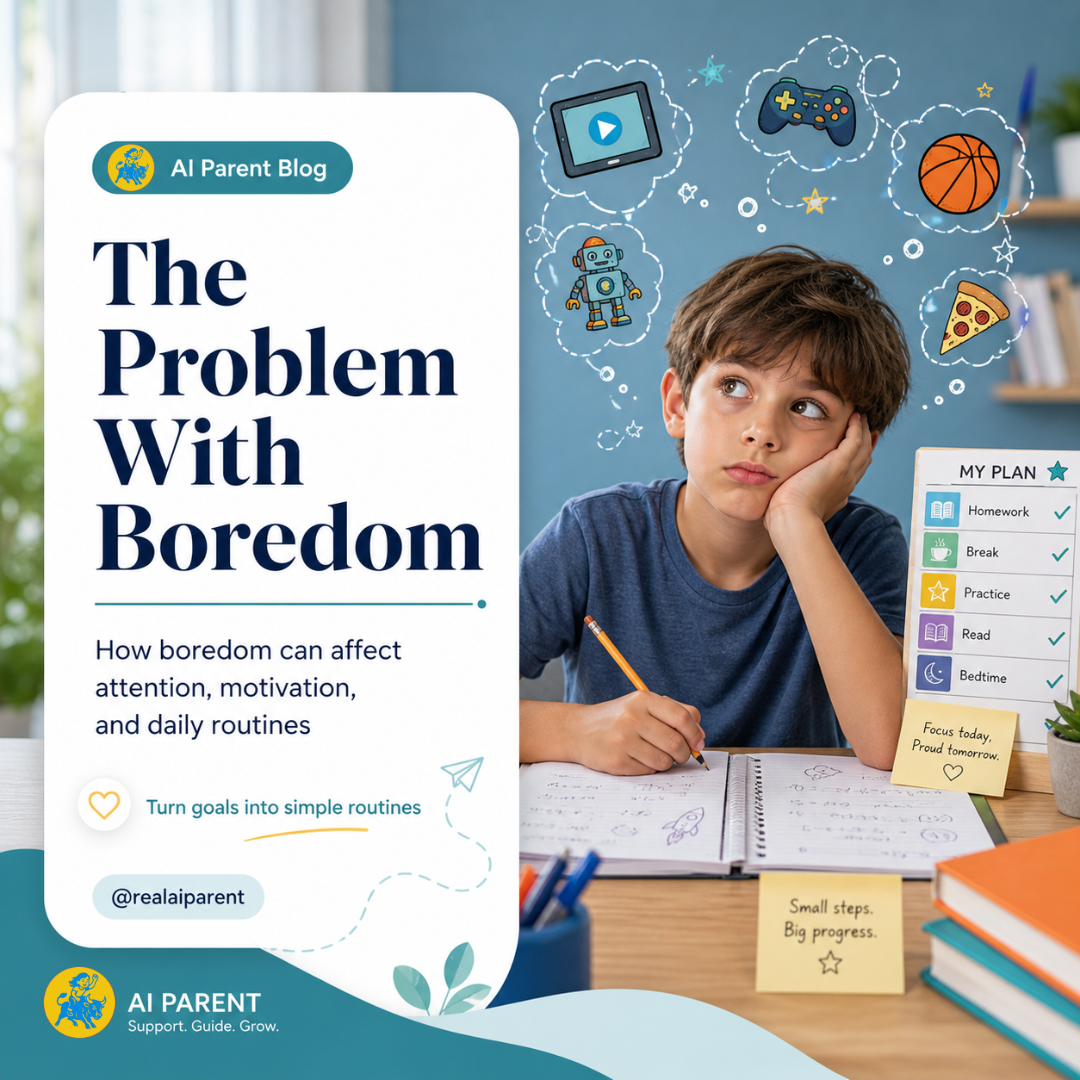
Boredom is not always a small thing
Boredom may seem harmless. A child says, “I’m bored,” and many parents hear it as a small complaint. But boredom can become a real problem when it repeatedly turns into avoidance, constant screen-seeking, low motivation, or difficulty staying focused.
Boredom is not the same as ADHD, and boredom does not automatically mean a child has attention-deficit/hyperactivity disorder. Still, boredom and attention problems can overlap. Some children who struggle with attention may also struggle when a task feels slow, repetitive, unclear, or not immediately rewarding.
For families, this matters because boredom is not always just “empty time.” Sometimes boredom is a signal that a child needs structure, challenge, movement, connection, or a clearer next step.
Why boredom feels so hard for kids
Adults often think of boredom as a chance to relax. For children, boredom can feel uncomfortable. A bored child may not know what to do next. They may feel restless, annoyed, or stuck. They may ask for a screen, interrupt others, wander around, or refuse to start homework.
That does not always mean the child is being difficult. Sometimes the child simply has not learned how to move from “I don’t feel like doing anything” to “Here is one small thing I can do now.”
I do not know where to start.
This feels too hard.
This is not interesting to me.
I want something faster and easier.
I need help breaking this into steps.
The danger of boredom becoming a habit
Boredom itself is not always bad. In small amounts, boredom can create space for creativity, imagination, independent play, and rest. The problem is when boredom repeatedly becomes the doorway into unhealthy patterns.
One danger is passive screen-seeking. If every bored moment is solved with a phone, tablet, video, or game, children may become less practiced at handling quiet time, slow tasks, or effortful learning. Screens are not automatically bad, but they can become a default answer to every uncomfortable moment.
Another danger is avoidance. A child may learn that if they complain about being bored long enough, they can escape homework, chores, reading, practice, or anything that requires effort. Over time, boredom becomes a way out of responsibility.
A third danger is low confidence. When a child repeatedly feels stuck, unmotivated, or unable to finish tasks, they may start believing they are “bad at school,” “not athletic,” “not creative,” or “not disciplined.” The boredom is no longer just about the activity. It becomes part of how the child sees themselves.
Boredom and attention problems
Attention problems are not just about refusing to focus. Many children can focus deeply on things that are exciting, fast, or rewarding. The challenge is often sustaining attention when something is slower, repetitive, difficult, or delayed.
That is where boredom becomes important. A child who is easily bored may struggle to stay with tasks that do not provide immediate feedback. Reading practice, math review, handwriting, instrument practice, sports fundamentals, and chores can all feel boring before they feel rewarding.
This does not mean every bored child has ADHD. It does mean parents should pay attention to patterns. If a child often cannot stay on task, forgets routines, avoids effort, loses things, daydreams excessively, or has significant problems at school, home, or with friends, it may be worth talking with a pediatrician, mental health professional, or qualified healthcare provider.
What children often need instead
Children do not always need more entertainment. Many times, they need more structure. A bored child may benefit from a clear next task, a short routine, a small goal, a visible schedule, a parent check-in, a way to mark progress, and a healthy balance of work, play, movement, and rest.
The key is to make the next step small enough to start. Instead of saying, “Go study,” a parent might say, “Read for 10 minutes, then mark it done.” Instead of saying, “Practice your sport,” a parent might say, “Do 10 minutes of footwork, then stretch.” Instead of saying, “Stop being bored,” a parent might say, “Choose one activity from your plan.”
That shift is powerful. The child moves from an open-ended feeling to a clear action.
How AI Parent helps
AI Parent helps families turn goals into simple routines. That matters because boredom often grows in the space between a goal and a plan.
A parent may want their child to read more, practice math, learn English, improve at soccer, complete homework, build a wellness routine, or prepare for a new skill. But without a plan, the child may not know what to do today. The goal feels too big, and boredom takes over.
With AI Parent, parents can create a plan with clear tasks and a schedule. The child can see what is due today, complete the task, and build consistency over time.
Read for 15 minutes.
Practice spelling words.
Do 10 minutes of basketball dribbling.
Stretch before bedtime.
Complete a homework check.
Boredom can become a planning opportunity
When a child says, “I’m bored,” it can become a useful parenting moment. Instead of immediately filling the silence, parents can use the moment to help the child practice choosing, starting, and following through.
What is one thing on your plan today?
Do you want to do your short task now or after snack?
Do you need help starting?
Should we make this task smaller?
What would make this routine easier to follow?
The goal is not to remove all boredom from childhood. The goal is to help children respond to boredom in healthier ways. Boredom can become the starting point for creativity, movement, learning, responsibility, or rest. That usually works better when children have a simple structure to lean on.
Final thoughts
Boredom is not always a small thing. For some children, boredom can lead to distraction, avoidance, frustration, screen-seeking, and low motivation. It can also overlap with attention problems, especially when tasks feel slow, difficult, or unclear.
AI Parent helps by giving families a practical way to turn goals into routines. When children know what to do next, they are less likely to get stuck in boredom and more likely to build confidence through small, completed steps.
The answer to boredom is not always more entertainment. Sometimes, the answer is a better plan.
Sources
- CDC: Symptoms of ADHD
- CDC: About ADHD
- National Library of Medicine / Frontiers in Psychiatry: Boredom proneness and inattention in children with and without ADHD
- American Academy of Pediatrics: Screen Time Guidelines