Parenting in the Age of AI: How AI Can Help Families Plan, Organize, and Grow
A practical guide to parenting with AI, planning family life, and using artificial intelligence as a helpful companion rather than a replacement for parents.
• 12 min read
Parenting has always involved planning. There are school schedules to manage, meals to prepare, appointments to remember, activities to coordinate, routines to build, household responsibilities to organize, and unexpected problems to solve. The challenge is often not deciding what matters. It is turning a goal into practical steps that fit real family life.
That is one of the most useful ways to think about parenting with AI. Artificial intelligence can help parents organize ideas, compare options, build routines, create schedules, prepare questions, and turn broad goals into an actionable parenting plan.
The positive impact of AI does not have to come from replacing human judgment. For families, AI may be most valuable when it works as a planning and thinking companion: the parent sets the goal, provides the context, reviews the suggestions, and decides what is appropriate.
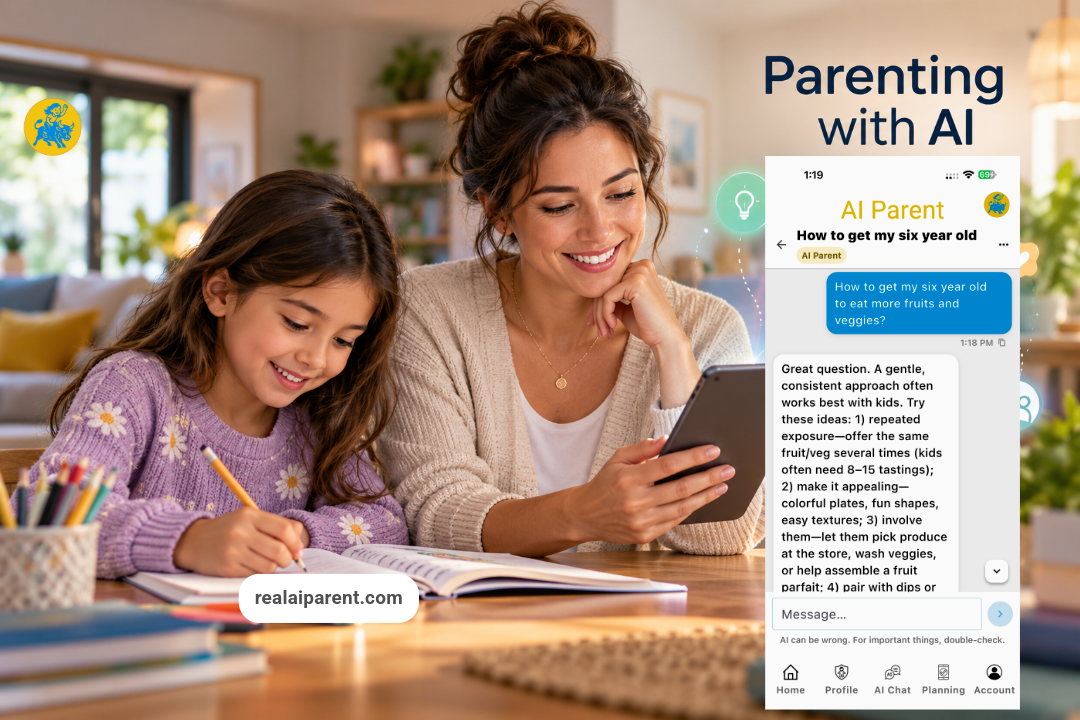
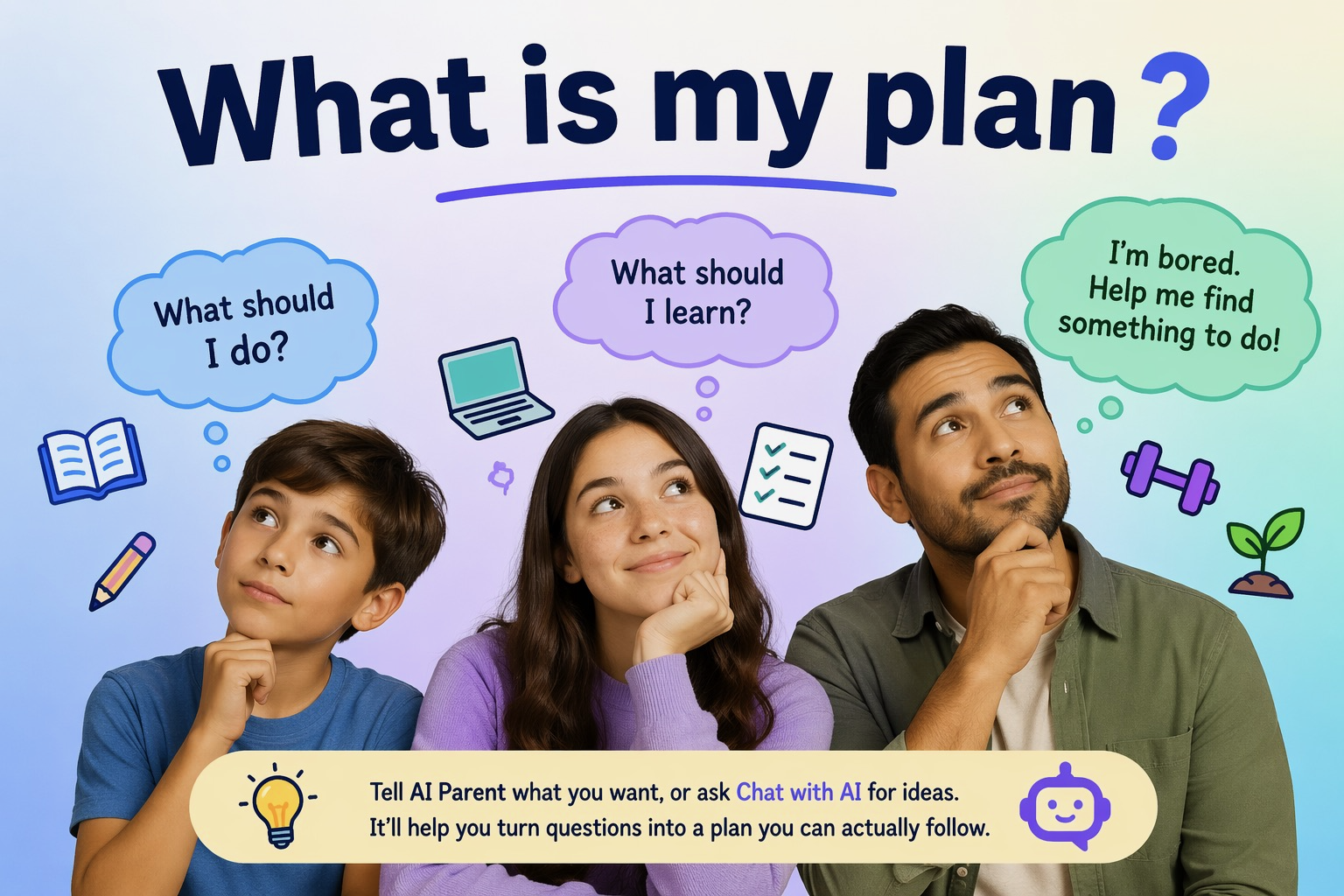
Tell AI what you want to accomplish. Then ask it to help you make the plan.
That simple idea can apply to homework, study schedules, morning routines, wellness goals, newborn responsibilities, household organization, exercise, screen-time habits, and many other parts of family life.
What Does Parenting With AI Actually Mean?
“AI for parenting” can sound futuristic, but many useful applications are ordinary and practical. A parent does not need a complicated technical workflow. The starting point can be a normal conversation.
A parent might ask:
- “My child needs to improve in math, but we only have 30 minutes after school. Make a realistic study plan.”
- “Our mornings are rushed. Build a routine so everyone can leave by 7:30.”
- “Help us reduce screen time without eliminating devices completely.”
- “Create a weekly family schedule around school, soccer, homework, meals, and bedtime.”
- “I have too much to remember. Turn this list into a prioritized AI to-do plan.”
Instead of starting from a blank page, AI can help structure the problem. That makes it useful as an AI planner, parenting planner, parent organizer, and family organizer.
The parent still chooses the objective. The parent still decides which suggestions make sense. AI helps organize the thinking between the goal and the next action.
The Positive Impact of AI Starts With Better Planning
Many family goals are easy to describe and harder to carry out. “Do better in school.” “Exercise more.” “Get to bed earlier.” “Be more organized.” “Spend less time on screens.” These are useful intentions, but they are not yet plans.
AI can help make those goals more specific by identifying steps, putting them in an order, assigning time, and adapting the plan around real constraints.
For example, “improve homework habits” might become:
- 3:30 PM — Snack and reset
- 4:00 PM — Homework
- 4:30 PM — Review the most difficult subject
- 5:00 PM — Free time
- 7:30 PM — Pack school materials for tomorrow

Planning becomes an ongoing process rather than a one-time decision.
If 30 minutes of homework is not enough, change it. If a child has practice on Tuesdays, create a different Tuesday schedule. If bedtime keeps slipping, revise the evening routine. If one plan does not work, ask AI to simplify it, shorten it, or offer alternatives.
This is where an AI planner can be more useful than a static checklist: the plan can evolve as the family learns what works.
AI as a Parent Organizer and Family Planner
Family life rarely involves only one schedule. Parents may be coordinating school, work, sports, medical appointments, homework, meals, chores, family events, personal goals, and multiple children at the same time.
A family planner becomes more useful when it does more than store dates. AI can help parents think about what needs to happen before an event, what should repeat every week, what can be prepared ahead of time, and which tasks can be moved when plans change.
Instead of only asking “When is this happening?”, an AI-powered planning system can help ask:
- What needs to happen first?
- What should repeat?
- Who is responsible?
- How long should this take?
- What can we prepare the night before?
- What changes if another activity is added?
An AI calendar can then become part of a broader planning system rather than simply a place to store appointments. An AI to-do list can connect the calendar to the steps required to prepare for what is next.
AI Can Be a School Planner, Homework Planner, and Study Companion
Education is one of the clearest places where planning can help. A student may have homework in several subjects, an exam in two weeks, a project due Friday, sports practice on Wednesday, and limited time each evening.
An AI school planner can break a larger academic goal into smaller daily actions. Instead of simply writing “study for math,” a plan might become:
- Monday — Review fractions
- Tuesday — Practice word problems
- Wednesday — Review mistakes
- Thursday — Complete a practice quiz
- Friday — Short final review
This same approach can be used for homework, reading goals, school projects, exam preparation, continuing education, and skill development. Parents can use AI to generate an initial structure and then adjust it around the child's actual workload and pace.
AI can also help explain concepts. When a student gets a problem wrong, the useful response is not always the final answer. A better educational interaction may walk through the reasoning, explain the steps, identify the mistake, and allow follow-up questions.
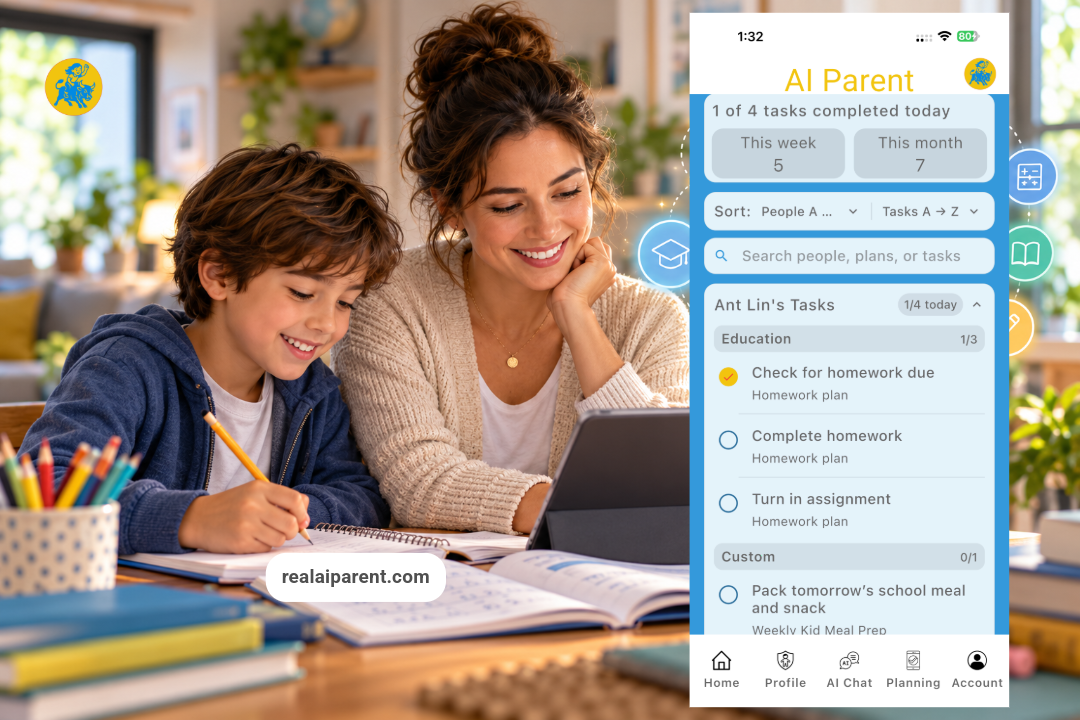
It is helping a student understand what to do next.
A structured school plan can also reinforce consistency. For more on turning goals into repeatable activities, see What a Plan Is, and How to Make One and The AI Parent System and Method.
Using AI to Coach Yourself as a Parent
One of the less obvious uses of AI is self-coaching. Parents often make decisions while tired, rushed, frustrated, or balancing several responsibilities. AI can provide a structured place to think through a situation before deciding what to do.
A parent might ask AI:
- “Help me think through why our bedtime routine keeps failing.”
- “Give me three realistic ways to make our morning routine easier.”
- “What questions should I ask myself before changing this rule?”
- “Turn this goal into something we can work on for 15 minutes each day.”
- “Help me review what worked this week and adjust next week's plan.”
- “Give me a calmer way to structure this conversation with my teenager.”
AI does not know a child better than the parent. It does not see every interaction or understand every family value unless that context is provided. Its value is in helping organize thoughts, surface alternatives, and turn an unclear problem into possible next steps.
This can be especially useful when combined with reflection. Ask AI for several options, identify the one that best fits the family, try it, and then return with the result. The process becomes: think → plan → try → review → adjust.
Newborn Planner Support, Baby Planning, and Infant Care Organization
The arrival of a baby creates a different planning challenge. Feeding, sleep, supplies, appointments, household responsibilities, parental rest, and countless small tasks can become difficult to keep organized.
AI can provide newborn planner support by helping parents create lists, divide responsibilities, prepare for appointments, and organize recurring household tasks. A baby planner can make responsibilities more visible, while an infant care plan can help parents structure the routines they choose to follow.
Parents might use AI to organize:
- supplies and restocking lists
- questions to bring to pediatric appointments
- household responsibilities between caregivers
- nighttime task coordination
- family support and visitor planning
- meal preparation and errands
- return-to-work preparation
For newborn care and infant health, AI should be treated as an organizational and educational assistant, not as a substitute for a pediatrician or other qualified medical professional. When a question concerns a baby's health, symptoms, feeding safety, medication, or urgent care, professional medical guidance is the appropriate source.
Using AI as a Wellness Planner
Parents have goals of their own. Exercise, sleep, nutrition, grooming, stress management, work, and personal development can all become harder to maintain when family responsibilities consume most of the day.

An AI-powered wellness planner can turn those goals into routines that fit within family life.
Instead of “I need to exercise more,” a parent might ask for three 20-minute workouts that fit around work, school pickup, and bedtime. Instead of “we need healthier evenings,” a family might create a routine that includes dinner, a short walk, homework, device-free time, preparation for tomorrow, and a consistent bedtime.
The benefit is not that AI makes the choice for the family. The benefit is that it can make the goal easier to visualize, schedule, and revise.
Can AI Help Families Reduce Screentime?
Screen-time conflicts are often less about a single device and more about what happens before, during, and after device use. A vague rule such as “use the tablet less” can be difficult to follow.
A family that wants to reduce screentime or reduce screen time can ask AI to help create a gradual plan around the family's current habits. That might include:
- defined device-free periods
- homework before entertainment
- outdoor or physical activity
- reading or creative time
- device-free meals
- a consistent point when devices are put away before bed
The plan can be adjusted by age, school workload, family rules, and the kinds of devices being used. A workable plan is more useful than an unrealistic rule that no one follows.
AI Planning During Difficult Family Transitions
Families sometimes face circumstances that require much more than ordinary scheduling. Divorce, separation, changing custody arrangements, financial stress, caregiving, or recovery from addiction can create both practical and emotional complexity.
In these situations, AI can still be useful for organization, but its role should be limited and clear.
Divorce support and planning
Someone looking for divorce support or a divorce planner may use AI to organize questions for an attorney, prepare a moving checklist, track documents, list deadlines, coordinate household logistics, or think through a changing family calendar. Legal rights, court strategy, financial consequences, and case-specific advice should be handled with appropriate qualified professionals.
Addiction help and recovery organization
Someone seeking addiction help may use AI to organize routines, write questions for a treatment provider, plan transportation to appointments, track personal goals, or identify topics to discuss with a counselor. AI is not a substitute for addiction treatment, emergency assistance, or professional healthcare.
The same principle applies across difficult situations: AI can help organize information and next steps without pretending that every family problem can be solved by software.
An AI Calendar Can Connect a Goal to the Days Before It
Traditional calendars are good at answering when. An AI planner can also help a family think about what needs to happen beforehand.
A calendar might say:
Science test — October 16.
An AI-assisted plan can work backward:
- October 9 — Review notes
- October 11 — Practice key concepts
- October 13 — Complete practice questions
- October 15 — Short final review
A calendar might say:
Soccer — Tuesday at 5:00 PM.
A family planner can also account for homework, travel time, dinner, equipment, water, and what needs to be packed in advance.
That is the difference between recording an event and planning around an event.
From One AI Prompt to a Daily Parenting Plan
Imagine telling an AI:
“My 10-year-old has school from 8:00 to 3:00, soccer Tuesdays and Thursdays, struggles with multiplication, and spends too much time on the tablet. Build a realistic weekday plan.”
AI can break the problem into school, homework, math practice, sports, meals, recreation, screen time, preparation, and bedtime.
Then the parent can refine it:
- “Thirty minutes of homework isn't enough.”
- “Move dinner earlier on soccer days.”
- “Friday should be less structured.”
- “Add 15 minutes of multiplication practice.”
- “Give us more family time.”
- “Make the routine simpler so my child can follow it independently.”
This back-and-forth is where AI becomes more than a search box. It becomes an iterative planning tool.
AI Can Help Parents Ask Better Questions
The first AI answer is not always the most important part of the interaction. AI can also help parents define the problem more clearly.
For example, instead of asking only “How do I fix bedtime?” a parent can explore:
- What time does the routine currently start?
- Which step creates the most resistance?
- Is homework pushing everything later?
- Are devices being put away early enough?
- Is the routine too long?
- Could part of it be prepared earlier in the evening?
Better questions can lead to a better plan. This is one reason AI coaching can be useful even when the parent ultimately rejects the AI's first suggestion.
Parenting With AI Still Starts With the Parent
Artificial intelligence will continue becoming more capable, but better technology does not eliminate the need for parental judgment.
Children are different. Families are different. Circumstances change. An AI system does not experience the household, observe every interaction, understand every value, or know every important detail unless the parent provides that context.
Parents provide the judgment. AI can provide structure.
That relationship is a useful way to think about AI for parents: You decide where your family should go. AI can help you make the plan for getting there.
Practical Ways to Start Parenting With AI Today
You do not need to reorganize your entire household at once. Start with one problem that would benefit from a clearer plan.
- Choose one goal. Homework, bedtime, exercise, school preparation, organization, screen time, or another priority.
- Give AI the important context. Ages, available time, current schedule, constraints, and what has or has not worked.
- Ask for a simple plan. Request specific steps rather than general advice.
- Review the plan. Remove anything that does not fit your family.
- Put useful steps on a schedule. Turn ideas into tasks that can actually be completed.
- Try the plan. Real experience will show what works.
- Return to AI and revise it. Explain what happened and ask for a better version.
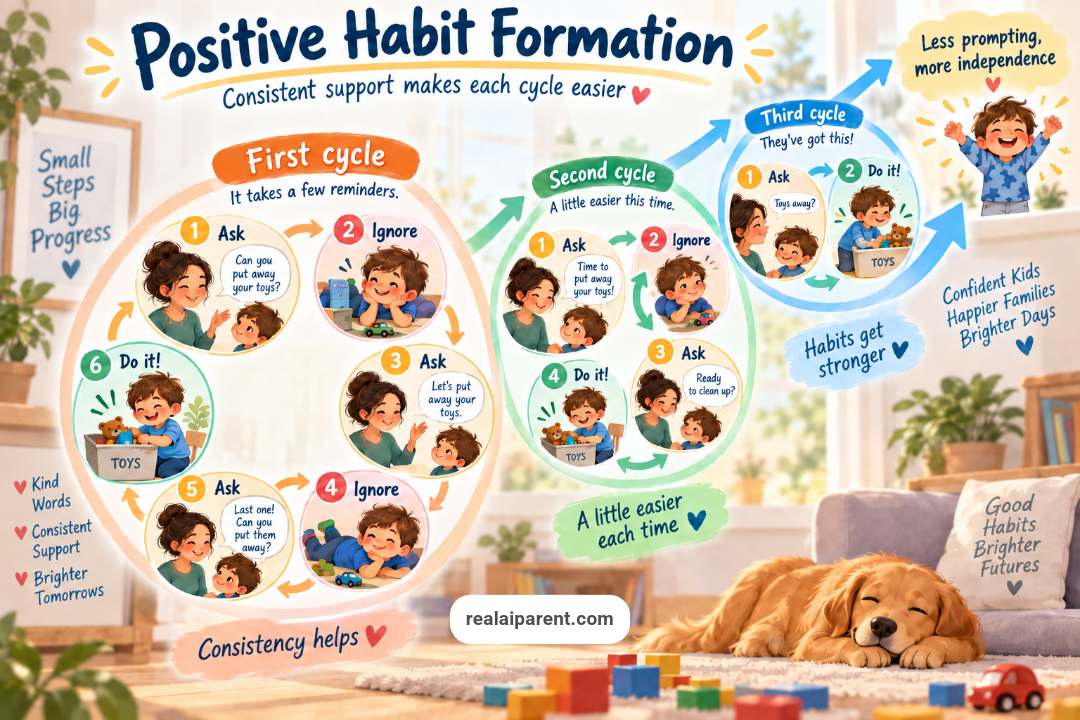
If routines are the goal, see Why Routines Matter for Children, Adults, and the Whole Family. If repeated resistance is making a routine harder, see Breaking the Negative Habit Loop.
Make the Plan With AI Parent
AI Parent is built around the idea that a broad goal becomes more useful when it turns into clear actions. Create a profile, choose a goal area, generate a plan, review scheduled tasks, and keep adjusting the plan as circumstances change.
You can use AI Parent to:
- create a parenting plan or family routine
- organize homework and school goals
- build recurring task lists
- plan sports, wellness, workouts, and personal development
- organize family responsibilities
- create custom plans around specific goals
- use AI chat to think through ideas and next steps
Parenting in the age of AI does not have to mean giving technology more control. It can mean giving parents better tools to organize what matters.
You know what your family needs. AI Parent helps you make the plan.
Download AI Parent and start planning for free: