The AI Parent System and Method
The Way to Form Good Habits
• 12 min read
A difficult routine does not have to stay difficult forever.
In our previous article, Breaking the Negative Habit Loop, we looked at what can happen when a parent repeatedly tries to establish a routine, the child repeatedly ignores or resists it, and eventually the parent gives up.
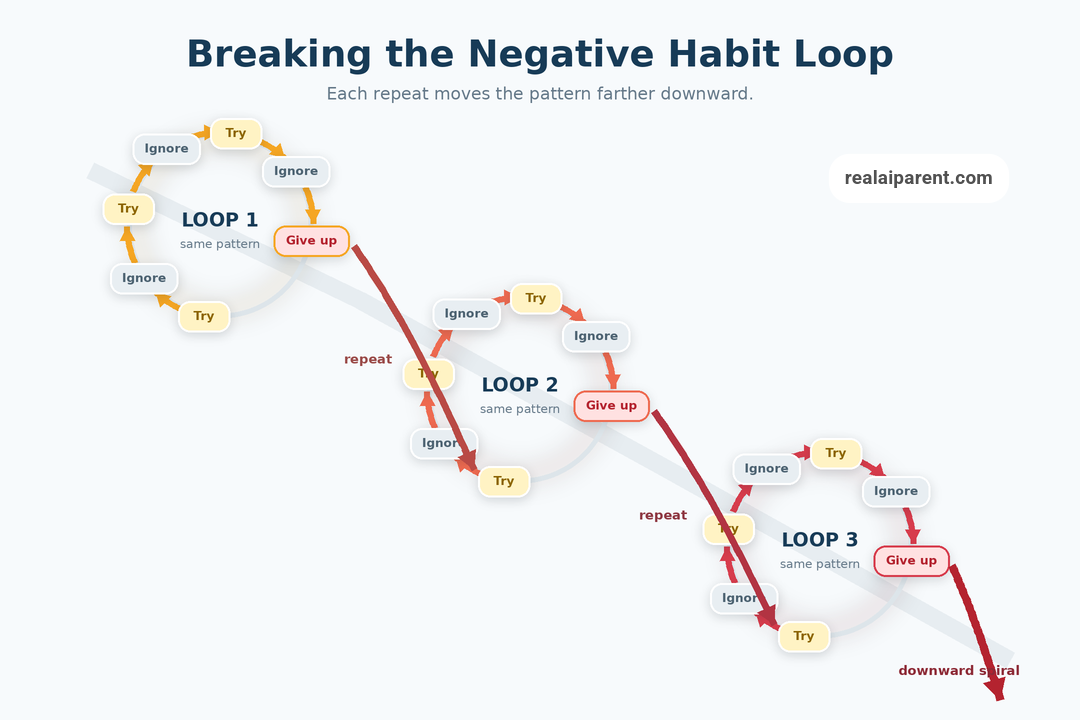
The negative cycle can look something like this:
Try → Ignore → Try → Ignore → Try → Ignore → Give Up
Then it happens again.
Homework gets delayed. Bedtime gets pushed back. The morning routine falls apart. Practice gets skipped. The parent becomes more frustrated, the child becomes more resistant, and each new attempt can feel harder than the one before.

But what happens if the parent keeps the routine in place long enough for the child to eventually succeed?
The direction of the loop can begin to change.
Instead of repeatedly practicing giving up, the family begins practicing finishing.
That is the idea behind the AI Parent System and Method for positive habit formation: use a clear parenting plan, repeat manageable tasks, recognize completion, and give each new day another opportunity to succeed.
Turn the Negative Habit Loop Around
Imagine a parent asks a child to put away their toys.
The child ignores the request.
The parent asks again.
The child is distracted and still does not respond.
The parent calmly asks again.
This time, the child puts the toys away.
The first cycle might look like this:
Ask → Ignore → Ask → Ignore → Ask → Do It
It took three reminders, but the important part is how the cycle ended: the task was completed.
Now the same situation happens again another day.
This time:
Ask → Ignore → Ask → Do It
The child still needed another reminder, but the routine became slightly easier.
Then, after enough practice, another cycle might look like:
Ask → Do It
The child already understands what is expected and has practiced successfully completing the task before.
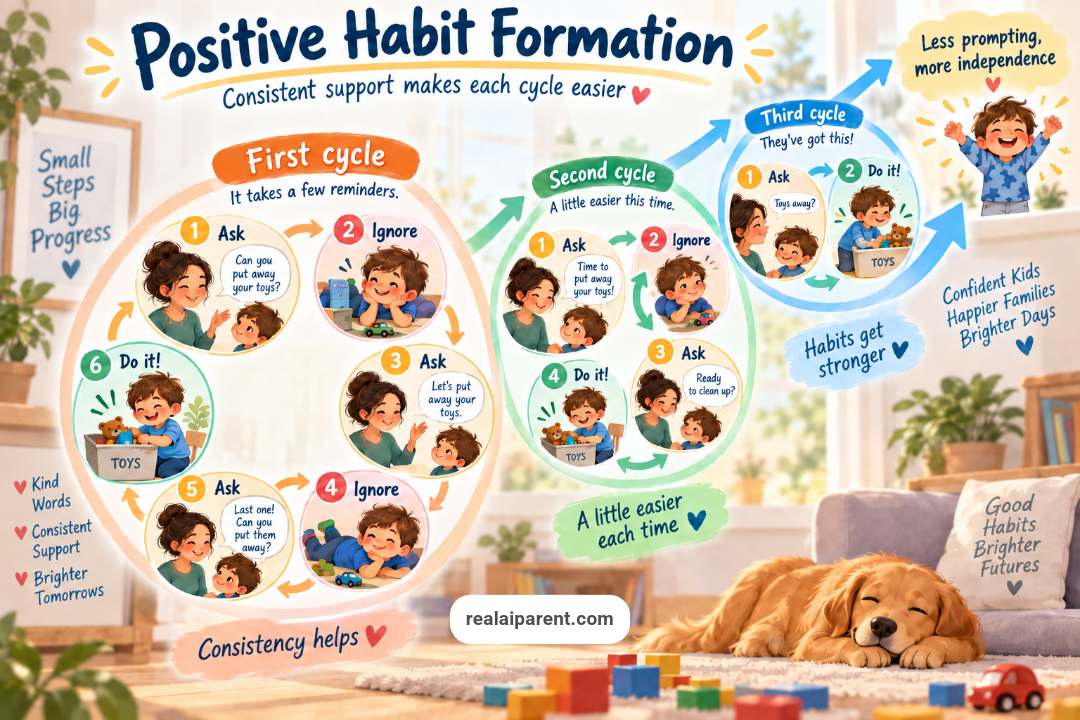
The positive loop moves upward:
More successful repetitions → greater familiarity → fewer reminders → more independent completion
This does not mean every child will follow three neat cycles or that every task will continuously become easier. Some habits may take five reminders. Others may take one. A child might do well for a week and then struggle again.
The exact number of cycles is not the point.
Keep giving the child opportunities to practice a successful ending.
Each Win Can Be Practiced Again
Good habits are rarely built from one major breakthrough. They are built from repeatable wins.
A child who successfully follows a bedtime routine tonight has an opportunity to practice it again tomorrow.
A child who finishes homework after school can repeat the same sequence the next school day.
A child who packs their backpack before bed can do it again the following night.
Each completed task gives the family another successful experience to build on.
Instead of asking “Why doesn't my child already do this automatically?”, it may be more useful to ask:
“How can we practice completing this successfully again?”
The more opportunities there are to repeat an achievable routine, the more opportunities there are to build familiarity with it.
That is why consistency matters.

The Goal Is Not Zero Reminders
Parents should not expect every new routine to immediately become automatic.
A reminder is not necessarily evidence that the routine has failed.
Children get distracted. They may be playing, tired, thinking about something else, unwilling to stop what they are doing, or they may simply forget.
A parent might need to ask once, twice, three times or more.
The positive habit loop does not require a specific number of reminders. The goal is to keep moving toward completion.
For one task: Ask → Ignore → Ask → Ignore → Ask → Do It
For another: Ask → Ignore → Ask → Do It
Eventually: Ask → Do It
And sometimes, after enough practice: See the routine → Do It
That last step is where the child begins taking greater ownership of the routine.
Some Routines Are Non-Negotiable
Not every task has the same importance.
Families typically have certain responsibilities that need to happen regardless of whether anyone feels particularly motivated that day.
A morning routine may include:
- Wake up
- Get dressed
- Brush teeth
- Eat breakfast
- Pack school materials
- Leave for school on time
A bedtime routine might include:
- Put away devices
- Prepare for tomorrow
- Shower or bathe
- Brush teeth
- Get into bed
- Go to sleep at the planned time
School-age children may also have recurring responsibilities involving:
- School attendance
- Homework
- Reading
- Studying
- Preparing for tests
- Packing school materials
- Limiting screen time
A consistent school planner or parenting planner can make recurring expectations visible instead of relying entirely on repeated verbal reminders.
These routines provide repeated opportunities for positive habit formation because the tasks return again and again. The family does not have to reinvent the routine every day. The plan already exists. The goal is to practice completing it.
Other Routines Can Be Flexible
Other goals are more optional.
A family might create plans involving:
- Art
- Music
- Sports
- Exercise
- Reading
- Math practice
- Writing
- Health and wellness
- Household responsibilities
- Personal development
Flexibility can matter here.
Suppose a child refuses to practice art today. Rather than turning art practice into a prolonged confrontation, the parent might say: “Okay. Let's work on math for 20 minutes instead, and we'll come back to art later.”
The child is still practicing the larger habit of following through on a planned activity.
Another child might dislike math but happily read for 30 minutes. Another may be highly motivated by sports. Another may enjoy music. Every child is slightly different. Every family is slightly different.
A useful family planner needs enough structure to create consistency and enough flexibility to adapt when something is not working.
Communication Is Part of the System
A schedule alone cannot create a healthy routine. Communication matters.
Parents can talk with children about:
- What needs to be done
- Why it matters
- When the task should happen
- How long it should take
- What is making the task difficult
- Whether the task should be changed
- What success looks like
As children get older, they can participate more directly in setting goals and deciding how to accomplish them. The parent still provides structure, but the child increasingly participates in the process.
The goal is not simply obedience. The longer-term goal is helping children learn how to plan, follow through, communicate, and take increasing responsibility for what they need to do.
Use AI Parent to Turn Goals Into Tasks
This is where AI Parent can help.
A broad goal is difficult to act on. For example: “I want my child to do better in school.”
That is a goal, but it is not yet a plan.
AI Parent can act as an AI planner, parent organizer, family organizer and AI to-do system by helping turn a goal into scheduled, actionable tasks.
Monday
- 4:00 PM — Complete homework
- 4:45 PM — 20 minutes of math practice
- 5:10 PM — Pack school materials
Tuesday
- 4:00 PM — Complete homework
- 4:45 PM — Read for 20 minutes
- 5:10 PM — Review tomorrow's schedule
Now the parent and child know what the next action is.
AI Parent plans can be created for education, sports, wellness, workouts, work responsibilities or other custom goals. Tasks can repeat on a schedule when consistency is needed, or they can be created as one-time activities when the goal does not need to repeat.
The important part is turning the idea into something that can actually be completed.
Completing the Task Creates the Positive Endpoint
Checking off a completed task may seem simple, but practically and emotionally it changes the end of the interaction.
Instead of: Ask → Ignore → Argument → Give Up
the family is working toward: Ask → Reminder → Complete → Check Off → Move Forward
The task has an ending.
The child can see that something was accomplished. The parent can see progress instead of only remembering what went wrong.
Then another opportunity appears tomorrow.
This creates a repeatable system: Plan → Do → Complete → Repeat
The routine does not need to be perfect.
It needs to keep producing opportunities for successful completion.
Start Every Day Fresh
With AI Parent, the task list refreshes each day.
That means yesterday's incomplete tasks do not have to define today.
A child may have missed several tasks yesterday. The morning routine may not have gone well. Homework may have been incomplete. A planned activity may have been skipped. Today is still a new day.
The family can open AI Parent, look at today's tasks, and start again.
The goal is not to carry yesterday's frustration forward. The goal is to keep striving for more completion today.
Do not let yesterday's incompletion hold back today's progress.
Start fresh. Complete what you can. Try to improve. Then do it again tomorrow.
Some days may have many completed tasks. Other days may have only one or two. The direction matters more than perfection.
Each task done, each day, is a win for the child and the parent.
A completed homework task is a win. Getting ready for school on time is a win. Reading for 20 minutes is a win. Putting away toys after several reminders is still a win. Finishing a bedtime routine is a win.
These individual successes create more opportunities to repeat the behavior and strengthen the routine.
Make Progress Visible
Parents can also use AI Parent to see how much is actually getting done.
Each profile includes a Tasks Completed count so parents can see accumulated progress.
That matters because daily family life can make improvement difficult to notice. A parent may think, “I'm constantly reminding my child to do things.” But the profile may show that dozens—or eventually hundreds—of tasks have actually been completed.
Instead of only noticing the reminders, the family can also notice the wins. Progress becomes visible.
Turn Everyday Progress Into a Game
AI Parent also includes the AI Parent Game.
Completed tasks earn points. Points contribute toward progress and levels.
This adds another positive endpoint to the routine: Complete a task → Check it off → Earn progress
For some users, simply seeing the checkmark is enough. Others may enjoy watching their points increase or trying to reach the next level. The purpose is to make progress visible and give users another reason to recognize completed work.
Keep the Streak Going
Consistency can also be reinforced through AI Parent Streaks.
Complete at least one scheduled task each day and the user's streak continues.
That creates a very small daily objective: Do at least one thing today.
On a difficult day, the family does not necessarily need to complete an enormous plan to preserve forward momentum. Complete one task. Check it off. Keep the streak alive. Come back tomorrow.
Small wins can accumulate.

Positive Habit Formation Can Apply to Almost Anything
The system is not limited to homework or chores. The same pattern can be applied to many goals.
Morning routine
Wake up → Get dressed → Eat breakfast → Pack → Leave
Bedtime
Devices away → Wash up → Brush teeth → Prepare tomorrow's items → Bed
Homework
Open assignment → Complete first section → Take short break → Finish work
Math practice
Start problem set → Complete practice → Review mistakes
Sports
Prepare equipment → Practice → Record completion
Wellness
Drink water → Exercise → Healthy meal → Sleep routine
Household responsibilities
Clear dishes → Put away belongings → Prepare for tomorrow
Screen-time routine
A family that wants to reduce screen time can schedule device-free periods, homework time, outdoor activity, reading, meals and bedtime as visible daily tasks.
Adult routines
The same principle can also apply to adults:
Exercise → Complete → Track it → Repeat
Study → Complete → Track it → Repeat
Work task → Complete → Track it → Repeat
Positive habit formation is not limited to one age. Starting routines early gives children more opportunities to practice planning and follow-through, but children, teenagers and adults can all work on building more consistent habits.
One Planning System, Different Family Needs
The same AI planning framework can support many kinds of everyday organization. A family may use AI Parent as a school planner, wellness planner, AI calendar, family organizer or daily AI to-do system. Parents can also create customized plans around newborn care, baby routines or an infant care plan when a family needs more structure during a new stage of life.
Families going through more complex circumstances may also use task planning alongside qualified professional support. For example, a parent may use a family planner to organize appointments and responsibilities while receiving divorce support, or to structure daily wellness tasks while a family member receives professional addiction help. AI Parent can organize goals and tasks, but it is not a substitute for legal, medical or behavioral-health professionals.
When a Routine Is Not Working, Adjust It
Consistency does not mean refusing to change a bad plan.
Sometimes the task is too difficult. Sometimes the timing is wrong. Sometimes the child needs help.
Sometimes the activity simply is not a good fit.
If a plan repeatedly fails, ask why.
- Could the task be smaller?
- Could it happen at a different time?
- Could the child choose between two productive activities?
- Could the parent participate the first few times?
- Could the task be broken into steps?
Positive habit formation should not become another rigid system that produces conflict. The system should help the family find achievable wins and practice them.
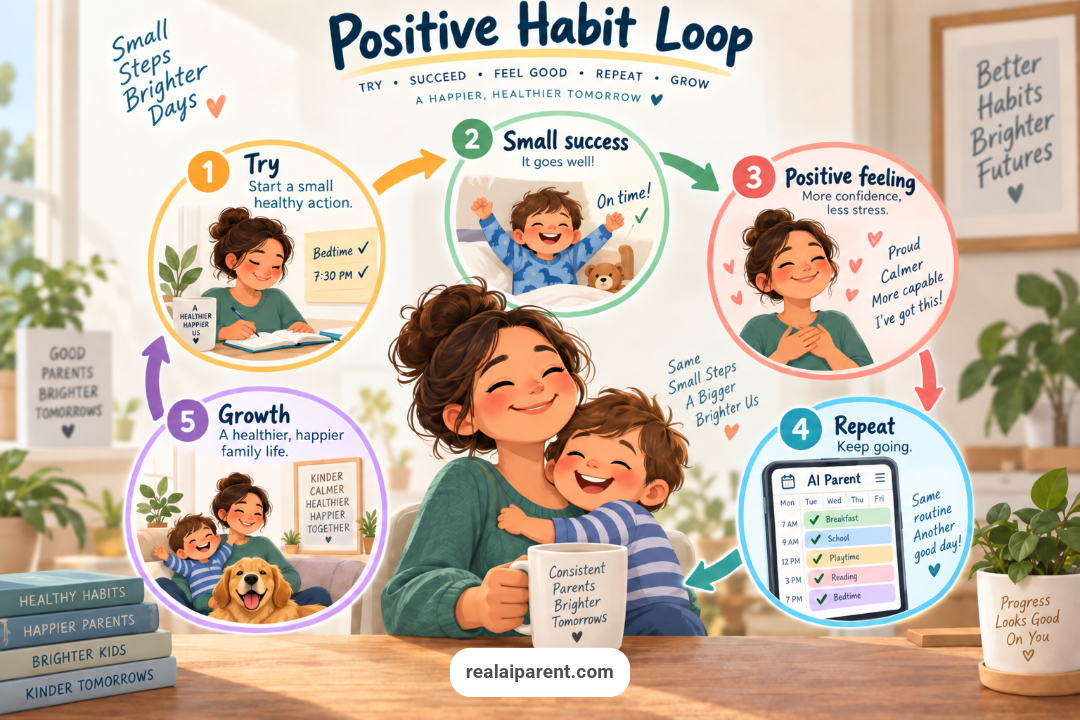
The Positive Habit Loop
The negative habit loop moves downward because every unsuccessful cycle can make the next attempt feel harder. The positive habit loop aims to move in the opposite direction.
Cycle One
Ask → Ignore → Ask → Ignore → Ask → Do It
It took several reminders. But the child completed the task.
Cycle Two
Ask → Ignore → Ask → Do It
Still not perfect. But easier.
Cycle Three
Ask → Do It
The child already knows the routine.
The number of cycles will vary. Progress will not always move in a perfectly straight line. What matters is that the family keeps creating opportunities to practice a successful ending.
Ask. Try. Complete. Repeat.
And over time, work toward: Know what to do. Do it.
That is positive habit formation.
Build the System Around Success
Parents do not need to create a perfect child, a perfect schedule or a perfect family. They need a workable system.
Set a clear goal. Turn it into manageable tasks. Put those tasks on a schedule. Communicate expectations. Allow reasonable flexibility. Keep returning to the routine. Complete the task. Mark the win. Start fresh tomorrow. Repeat it.
When a child struggles, do not automatically interpret the struggle as failure. It may simply be another repetition in the process. The first loop may require several reminders. The next may require fewer. Eventually, the routine may begin to feel normal.
Each completed task creates another successful experience that can be practiced again.
Each task done, each day, is a win for the child and the parent.
That is the idea behind the AI Parent System and Method:
Create the plan. Practice the routine. Complete the task. Recognize the win. Start fresh. Repeat.
Use AI Parent for parenting with AI that keeps the parent in control: turn family goals into clear plans, scheduled tasks and visible progress, and start building the next positive habit today.
Download AI Parent and start planning for free: