
Breaking the Negative Habit Loop: How Families Begin Spiraling Downward
• 11 min read
Every parent starts with good intentions.

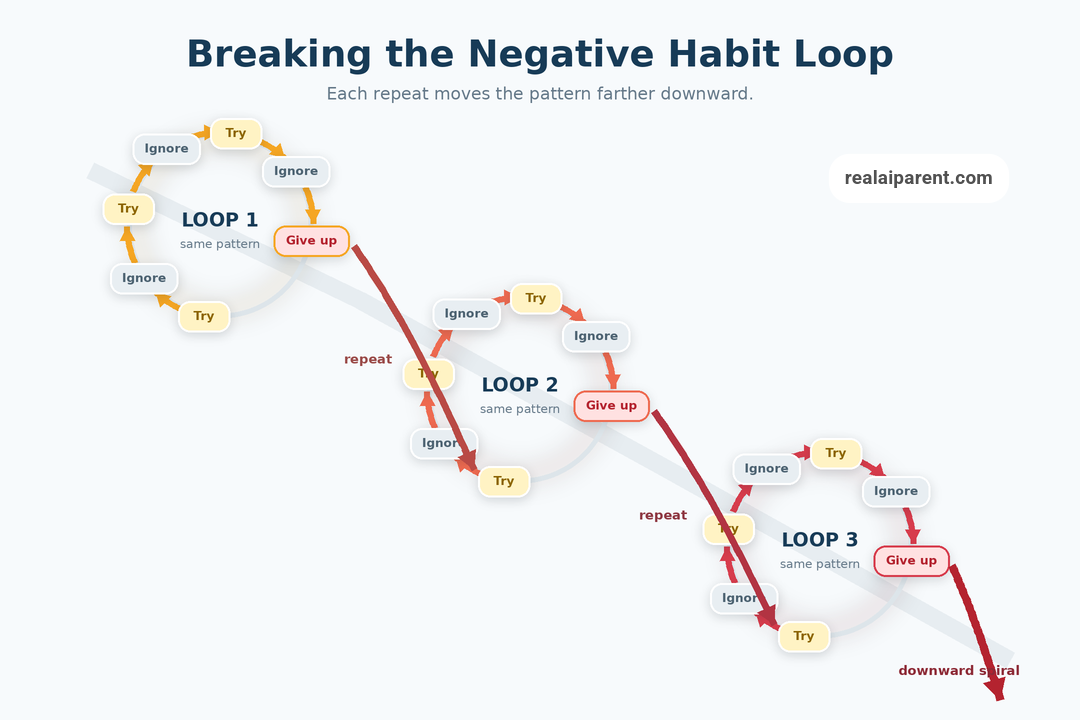
You introduce a morning routine. Your child ignores it. You try again. The routine is ignored again. You change your approach, offer another reminder and make one more attempt. When nothing seems to work, frustration takes over—and eventually, you give up.
The pattern looks like this:
Try → Ignore → Try → Ignore → Try → Ignore → Give up
Unfortunately, the cycle rarely ends there. The same problem returns, often with more resistance and less optimism. The parent tries again, the child disengages again, and the family moves through another loop.
Each loop takes the family a little farther downward.
Why the Negative Habit Loop Gets Worse
The first attempt at a new family routine often carries hope. A parent believes that a new morning schedule, homework checklist, bedtime routine or family plan will make life easier.
When the child does not cooperate, the parent may initially treat it as a temporary setback. But after several unsuccessful attempts, the emotional meaning of the situation begins to change.
The parent may start thinking:
- “Nothing I try works.”
- “My child does not listen to me.”
- “Why should I keep reminding them?”
- “This always turns into an argument.”
- “Maybe our family cannot follow routines.”

The child may develop a different but equally damaging interpretation:
- “My parent is always upset with me.”
- “I always fail at routines.”
- “If I wait long enough, the expectation will disappear.”
- “There is no point in trying now.”
- “I am already in trouble, so why start?”
The problem is no longer limited to one missed task. It becomes a repeated emotional experience of frustration, avoidance and perceived failure.
Loop One: Frustration
During the first loop, the parent is usually still motivated.
The parent creates a routine, gives instructions and expects the child to follow through. When the child ignores the plan, the parent repeats the request. The reminders may become more urgent, but there is still a belief that cooperation is possible.
For example:
- The morning checklist is introduced, but the child remains in bed.
- A homework schedule is created, but homework keeps getting delayed.
- A bedtime routine is discussed, but the child continues using a device.
- A sports practice plan is made, but practice repeatedly gets skipped.
At this stage, the family may treat the problem as a simple productivity or discipline issue. The parent tries harder, repeats the instructions and assumes that another reminder will solve it.
When it does not, the family enters the next loop.
Loop Two: Anxiety and Avoidance
By the second loop, both the parent and child may anticipate conflict before the routine even begins.
The parent may feel anxious about the morning because previous mornings were chaotic. The child may expect criticism and begin avoiding the routine earlier. A homework reminder that once sounded neutral may now feel like the beginning of an argument.
Avoidance then reinforces the problem.
The child delays starting. The parent delays addressing the issue because they do not want another confrontation. Tasks pile up, deadlines move closer and everyone becomes more stressed.
This can affect:
- Schoolwork and academic performance
- Sleep and morning readiness
- Grooming and personal hygiene
- Sports and extracurricular consistency
- Household responsibilities
- Exercise and wellness routines
- Family relationships
A family planner or parenting organizer cannot eliminate every disagreement, but without a consistent system, the parent’s brain often becomes the household’s only reminder system. That increases the mental load and makes every missed task feel personal.
Loop Three: Helplessness and Failure
By the third loop, the family may no longer expect the routine to succeed.
The parent has tried multiple times. The child has ignored or resisted multiple times. Both sides now have evidence—at least in their own minds—that the plan will fail again.
This is where frustration can begin to resemble helplessness.
The parent may stop making the checklist, stop opening the family calendar or stop asking whether the homework was completed. The child may interpret this withdrawal as proof that the routine never really mattered—or, more painfully, that the parent no longer believes in them.
The parent has not necessarily stopped loving or caring about the child. More often, the parent has become emotionally exhausted and has given up on the strategy.
However, from the child’s perspective, it can feel as if the parent has given up on the child.
That misunderstanding can deepen the downward spiral.

The Connection to Depression and Anxiety
A repeated family habit loop does not automatically cause a clinical mental health condition. However, the emotions reinforced by the loop—hopelessness, helplessness, frustration, avoidance and loss of motivation—can overlap with experiences associated with depression and anxiety.
The National Institute of Mental Health identifies hopelessness, helplessness, frustration, loss of interest, low energy and difficulty concentrating among possible symptoms of depression. These symptoms require professional evaluation when they are persistent or interfere with everyday life. National Institute of Mental Health: Depression
For a parent, repeated failure may create dread around ordinary family responsibilities. For a child, repeated criticism or perceived failure may create anxiety about starting tasks, asking for help or disappointing the parent.
The loop can then become self-reinforcing:
- A difficult task creates anxiety.
- Anxiety encourages delay or avoidance.
- Avoidance leads to another missed task.
- The missed task creates conflict.
- Conflict reinforces the belief that the next attempt will also fail.
This is why “just try harder” is often ineffective. Every unsuccessful attempt adds emotional weight to the next attempt.
When Failure Becomes an Identity
A missed routine is an event. It should not become an identity.
But repeated negative loops can change the language used inside a family:
- “You are lazy.”
- “You never listen.”
- “You always give up.”
- “I am a bad parent.”
- “I cannot do anything right.”
- “Our family is always disorganized.”
These statements turn temporary behavior into permanent labels.
Once that happens, the family is no longer discussing a specific morning, homework assignment or practice session. Parent and child are defending themselves against negative identities.
The child may resist to preserve a sense of control. The parent may become stricter because cooperation appears impossible. Both sides respond to the emotional history of the loop instead of the task happening today.
The Cost of Giving Up on the Routine
When a parent abandons a routine after several difficult attempts, there may be short-term relief. There are fewer reminders, fewer immediate arguments and less pressure.
But the original problem remains.
Homework is still delayed. Mornings are still chaotic. The child still struggles to get out of bed. Practice is still inconsistent. Personal hygiene, wellness or household responsibilities may continue to be missed.
The family also loses the opportunity to build trust through small, successful repetitions.
This is the real danger of the negative habit loop: each cycle makes the next attempt feel less worthwhile.
The downward spiral is not simply:
Try → Ignore → Give up
It becomes:
Try → Ignore → Conflict → Anxiety → Avoidance → Failure → Less trust → Try again with less hope
Breaking the Negative Habit Loop
The goal is not to create a perfect family routine overnight. The goal is to prevent one difficult experience from becoming a repeating pattern of helplessness and failure.
Start by making the plan smaller.
Instead of “Fix the entire morning,” create a parenting plan with three clear steps:
- Get out of bed.
- Get dressed.
- Pack the school bag.
Instead of repeatedly giving verbal reminders, place the routine in a shared family organizer, productivity planner or calendar app. Give each task a realistic time and make progress visible.
A useful family plan should:
- Define the next action clearly
- Assign a realistic time
- Send consistent reminders
- Track completed tasks
- Reduce repeated verbal prompting
- Allow the family to adjust the plan
- Treat missed tasks as information—not personal failure
Consistency matters more than intensity. A calm reminder repeated through a dependable system is often more sustainable than a burst of frustration after several missed tasks.
Use AI for Parenting Plans
AI Parent is an AI planner and organizer designed to help families turn everyday problems into practical plans.
Start with one sentence:
- “Mornings are chaotic.”
- “My child does not get out of bed.”
- “Homework keeps getting delayed.”
- “We need a better bedtime routine.”
- “We need a consistent tennis practice schedule.”
AI Parent can help turn that problem into a structured parenting plan with scheduled tasks, recurring reminders and progress tracking.
Instead of carrying every reminder in your head, you can use a family calendar and productivity system to keep the plan visible. When the routine becomes difficult, the plan remains in place—and the family has a clearer opportunity to reset instead of giving up.
AI Parent is AI for parents who want to replace repeated frustration with practical next steps.
A Difficult Routine Is Not a Failed Family
One missed task does not mean the plan has failed. One difficult week does not mean the child is incapable. One frustrated parent is not a bad parent.
The negative habit loop becomes dangerous when each unsuccessful attempt reduces hope for the next one.
Break the loop before frustration becomes avoidance, avoidance becomes helplessness and helplessness becomes surrender.
Make the next step smaller. Put it on the calendar. Keep the reminder calm. Track the progress. Adjust the family plan—and try again with support.
Download AI Parent and start planning for free:
https://realaiparent.com/?utm_source=blog&utm_medium=organic&utm_campaign=negative-habit-loop#download
AI Parent is a planning and productivity tool, not a substitute for professional mental health care. If depression, anxiety, hopelessness or family conflict is persistent or affecting daily functioning, consider contacting a qualified health professional. In the United States, call or text 988 if someone is experiencing a mental health crisis.